Green Valley, AZ · Garage Door Service
Garage Door Installation Built for Green Valley's Heat and Housing Stock
Garage door installation for Green Valley homes built 1986-2006, matched to panels and hardware built for Arizona's severe summer heat and UV. Book a visit.
- Repairs & new doors
- Springs & openers
- Serving 4 nearby communities
What You Are Seeing
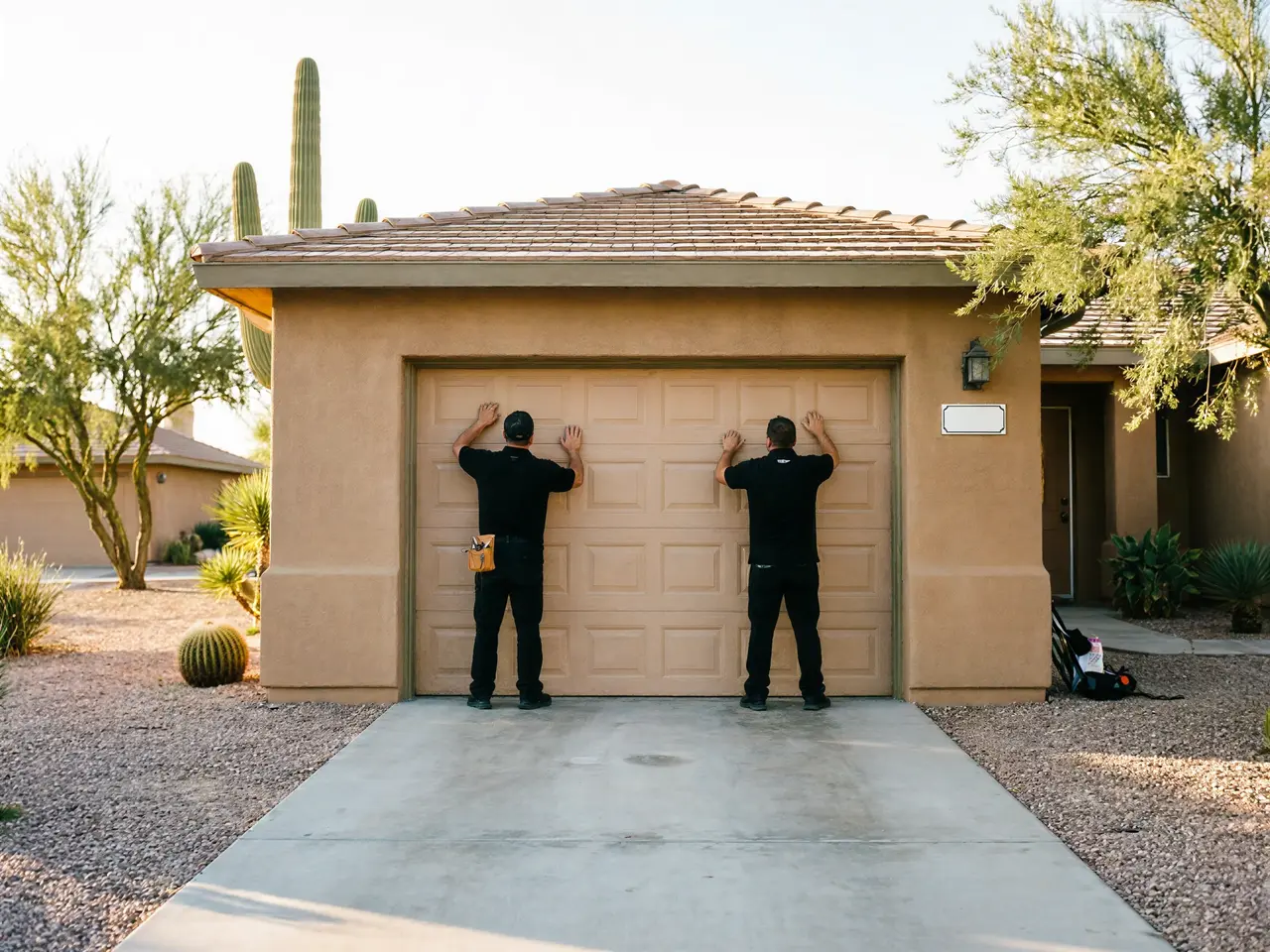
Most of the calls we get for new installs in Green Valley come from one of two spots: a door that's original to the house, or a replacement that was sized for a different climate. Green Valley's housing mostly went up between 1986 and 2006, with the median build year sitting around 1996. That means a lot of the garage doors out there are the same builder-grade steel panels that came standard back then - single-skin, non-insulated, with hardware rated for a much gentler climate than the one they've actually been living in. After twenty to thirty-five years of Arizona sun, those panels don't fail all at once. You see it as a door that's gone wavy along the bottom two panels, hinges that have worked loose from the steel flexing in and out with the heat, or an opener that now strains and reverses on a door it used to lift without a sound. None of that is a wiring problem or a remote control problem - it's a door and track system that was never built to last this long in this heat, and it's finally showing its age at the same time as most of its neighbors.
Why This Fails Locally
This isn't a one-house problem. Across Green Valley's four main built-out areas, the housing stock is almost all 1980s and 90s construction, which means thousands of garage doors from the same handful of manufacturers, installed to the same codes, all aging on the same clock. Pair that with a climate band rated severe for heat, and you get a predictable failure pattern: steel panels expand and contract every single day, track brackets that were torqued down in the mid-90s work loose, and the factory lubricant on rollers and hinges dries out and turns to grit years before it would in a milder climate. Torsion springs rated for a certain number of cycles get there faster when the garage itself runs hot enough to thin the steel's temper slightly over decades. None of this shows up as one dramatic break - it shows up as a door that's slowly gotten louder, heavier to open by hand, and harder on the opener motor. By the time a homeowner calls about installation instead of repair, the door and the opener have usually been fighting the heat for a long time, and patch repairs stop making sense once the frame and track are as worn as the panel skin.
Doing It Yourself
You can swap a set of rollers or hinges yourself if you're comfortable on a ladder, and plenty of Green Valley homeowners do. What you shouldn't do is touch the torsion spring - it's wound under enough tension to break bones, and that doesn't change no matter how many online videos make it look simple. Sizing a new door is also where DIY installs go wrong in this area specifically: houses built through the 1986-2006 run here often have stucco-framed openings that are a half-inch or more off true, and a door ordered to the printed opening size instead of the actual measured one won't seal right against summer heat or dust. We also won't pretend every door here needs replacing - if the track and opener are sound and it's just a panel or a seal, a repair is the honest call, and we'll tell you that instead of selling a full install you don't need. If you do want to measure and order parts yourself, know that odd panel heights from older builder-grade doors sometimes take longer to source than current stock sizes.
How to Book
If you've measured your opening, or if you'd rather someone else deal with the stucco and the spring tension, book a visit through the site. We cover Green Valley and the surrounding area - Quail Creek, Rancho Sahuarita, Sycamore Canyon, Amado, Corona de Tucson, Summit, and Tubac. With roughly 5,010 households and 3,810 owner-occupied houses in the service area, and a median household income around $82,273, most homeowners here end up choosing a full install over another round of patch repairs once the door's past fifteen or twenty years old - it's usually the cheaper path over time once you add up what a strained opener and a leaking seal cost in summer cooling. Start at the homepage to get on the schedule.
Frequently asked questions
Will a new garage door fit my 1990s opening without modification?
Not always without checking first. Homes built through the 1986-2006 run here were framed with stucco openings that can be off true by a half-inch or more, so we measure the actual rough opening rather than ordering to the printed size. That's the step that gets skipped most often in DIY installs and causes seal gaps later.
Do you install doors built for Arizona heat?
Yes, we size and spec doors for the severe heat band Green Valley sits in, which matters more here than in milder climates because steel panels and weatherstripping age faster under constant expansion and UV exposure. That's also why a lot of original builder-grade doors from the 1990s are failing now.
What areas do you serve besides Green Valley itself?
We work throughout Green Valley and the nearby communities of Quail Creek, Rancho Sahuarita, Sycamore Canyon, Amado, Corona de Tucson, Summit, and Tubac.
Is it ever better to repair instead of replace?
Often, yes. If the track, opener, and frame are sound and the problem is a panel, seal, or a few rollers, a repair is the honest call and costs less than a full install. We'll tell you when that's the case instead of pushing a replacement you don't need.
Book garage door service in Green Valley
Call now or request a quote - tell us what the door is doing and where you are.