Green Valley, AZ · Garage Door Service
Garage Door Roller Replacement, Green Valley AZ
Worn rollers on 1986-2006 Green Valley homes crack and bind faster under severe desert heat. Here's what fails, why, and how we fix it right.
- Repairs & new doors
- Springs & openers
- Serving 4 nearby communities
What You Are Seeing
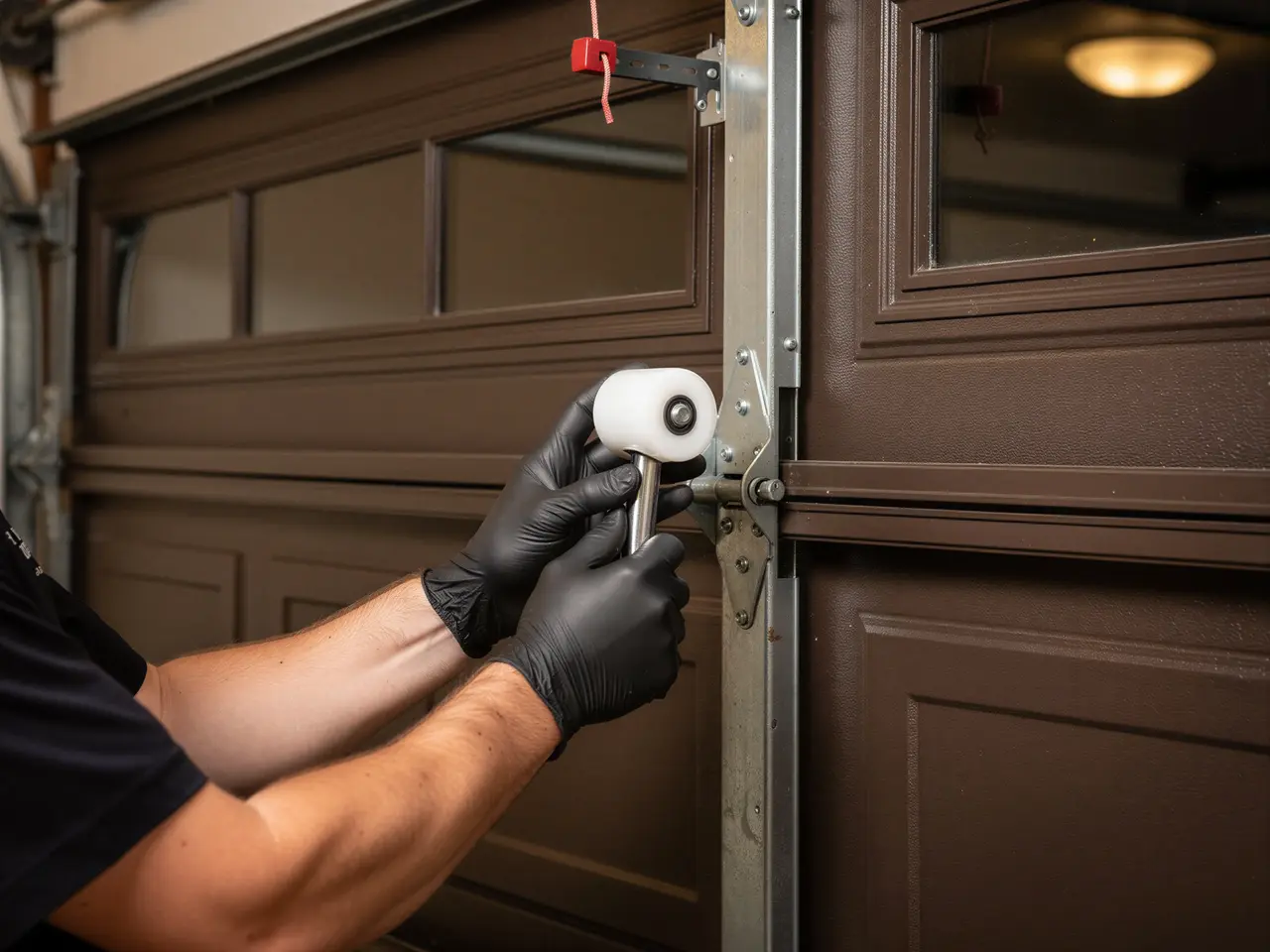
If your door grinds, jerks, or pops when it moves, the rollers are usually the first thing to check before you start blaming the opener. Nylon rollers wear from the inside out: the wheel looks fine from three feet away, but the stem or bearing is shot and the door starts riding crooked in the track. You'll hear a rhythmic thunk as each bad roller passes a hinge, or feel the door hesitate at the same spot on every cycle.
Steel rollers show it differently. They don't crack, they flatten on one side, which throws the door off-center in the track and chews up the track edge itself. Either way, the symptom that brings most people to search for this is noise that's gotten worse over a few months, not something that happened overnight.
Across the Green Valley service area, most of the housing stock went up between 1986 and 2006, with a median build year around 1996. That means a lot of doors out here are on their second or third roller set already, and a chunk of them are original hardware that's simply aged out. The roller itself is a cheap part. What it does to the track, the hinges, and the opener's travel limits if you ignore it is not cheap.
Why This Fails Locally
Rollers don't wear out from use alone, they wear out from heat cycling. Green Valley sits in a severe heat climate band, and a garage that sits closed all day turns into an oven that then cools fast at night. Nylon rollers expand and contract with that swing every single day, and the stem-to-wheel bond is the first thing to go brittle. Steel rollers fare a little better on heat but still run dry faster here, since any lubricant on the bearing cooks off quicker than it would in a milder climate.
The age of the housing stock compounds it. A door built when the neighborhood went up in the late 80s through the mid-2000s has had fifteen, twenty, even thirty years of that heat cycling on the same track and roller geometry, often with the original hardware never touched. By the time a homeowner notices the noise, the rollers have usually already scored the track, and a roller-only fix won't quiet the door down completely.
This isn't a Green Valley-specific design flaw, it's math: more heat cycles per year, applied to housing stock that's old enough to have absorbed thousands of them, produces roller failure earlier and more often than you'd see in a cooler region with newer doors.
Doing It Yourself
Swapping a single roller on a residential door is within reach for most homeowners if the door is down, the opener is disconnected, and you're not touching anything near the bottom brackets - those are under spring tension and that's not a DIY repair. Pull the hinge pin, slide the old roller out, grease and slide the new one in, replace the pin. Ten minutes a roller once you've done one.
Where people get into trouble is replacing all ten rollers at once without checking the track first. If the track has visible dents, bows, or gouges from a roller that already failed, a fresh set of rollers dropped into a bad track will wear out again in a year, sometimes faster. It's worth sighting down the track from the end before you buy parts.
The other limitation worth saying plainly: if your rollers are original to a door from the 1990s or early 2000s, matching the stem length and wheel diameter to what's currently installed can be harder than it sounds, and a mismatched roller binds instead of rolling. We don't sell parts over the counter, so if you're not sure what you're looking at, it's a quick call rather than a guess at the hardware store.
How to Book
If the noise, the crooked ride, or the flat spots on the wheels match what's described above, call and describe what you're hearing and we'll tell you honestly whether this is a roller job or something the rollers are just a symptom of. We cover the Green Valley service area and the surrounding communities under the same roof. Reach us through the site to get scheduled.
Frequently asked questions
How long do garage door rollers last in Green Valley's heat?
It depends on the roller type and how often the door cycles, but the severe heat band here means daily expansion and contraction that shortens nylon roller life compared to milder climates. Many homeowners with original hardware from the 1986-2006 building period are replacing rollers for the first or second time now.
Can I replace just the noisy rollers instead of the whole set?
Yes, if the track underneath them is still straight. Replacing only the rollers that are visibly cracked or flat is common and saves money, but we check the full track and the rest of the set while we're there so you're not calling again in six months for the next one to fail.
Will new rollers fix a door that's loud everywhere, not just at one spot?
Sometimes, but a door that's loud all the way through the cycle more often points to a dry or bent track, loose hinges, or an opener issue stacked on top of roller wear. We'd want to look at it rather than guess, since swapping rollers on a bent track doesn't solve the noise.
Related services
By Neighborhood
Roller Replacement across the Green Valley area
We also handle roller replacement in these Green Valley-area suburbs.
Book garage door service in Green Valley
Call now or request a quote - tell us what the door is doing and where you are.